Realizing73 of 80
Suffering Comes From Bonding Meaning To Nothing
(Never Give a Toddler a Label-Maker)
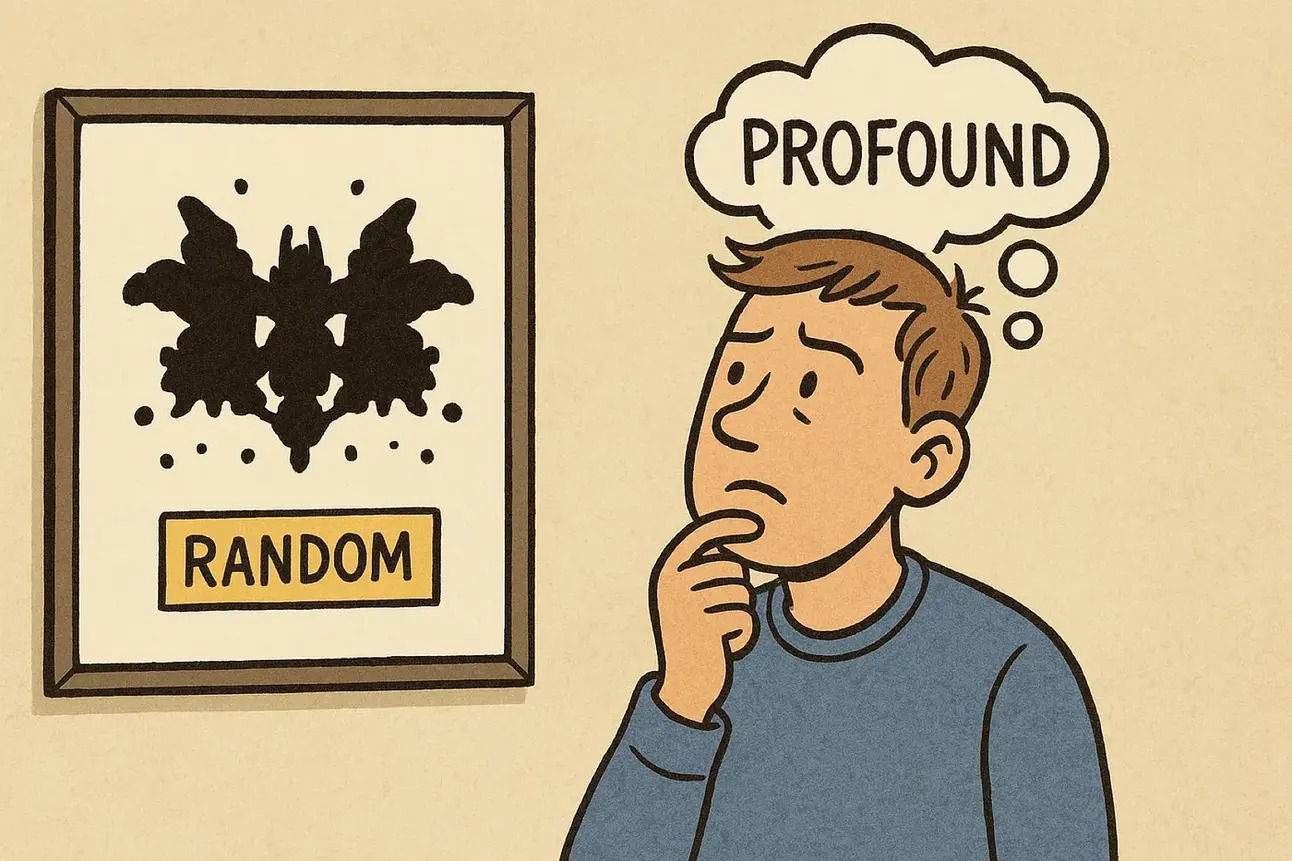
One of the most profound insights I’ve had in the past decade of self-exploration is realizing that the Voice in my head isn’t me.
That came from psychedelics.
Then I realized it wasn’t just one voice, but a whole ensemble.
That came from Internal Family Systems therapy.
Both led me to a better understanding of what was going on in my head, but didn’t particularly make my life any easier. I was still searching for meaning and trying to become somehow a “better” version of myself.
It was continuous. It was exhausting.
But then I came across Robert Scheinfeld’s teachings and I finally understood how these Voices fit into a broader worldview. It was a little tough to get my head around, but once I did, puzzle pieces started snapping into place, creating a coherent overall picture of who I am and what life means.
Part of this picture is understanding that the purpose of the Voice is to keep up a running narrative and generate internal drama that distracts me from realizing that I’m more than just the character I play in my life story.
The purpose of the Voice is to make me forget who I really am, and the most effective method used to accomplish this is what I call the Bonding Trick.
The bad news is you can’t get rid of the Voice.
The good news is you can spot the Voice’s Bonding Trick and stop falling for it. You can stop allowing harmless experiences to turn into high-stakes drama, and enjoy a more balanced, effortless existence.
You just have to notice what’s really happening.
If events in my life were allowed to appear and dissolve on their own, I would never suffer. Sensations would arise, emotions would swell, thoughts would flicker, and all of it would pass like a summer cloud, unclaimed, uninterpreted, blissfully uneventful.
I’d simply be entertained by a sort of experiential improv. The Author, the Creator, what you might call God… cues the lights and action. I blink. Scene change. No drama. No over-arching plot. No personal growth montage set to cello music.
Unfortunately, there is this Voice in my head.
The Voice is my in-house unreliable narrator, uninvited and deeply invested in its own job security. Deeply invested in the perpetuation of the simulation.
The Voice has never met a neutral event it didn’t want to emotionally monetize. The Voice can’t just see a tree and call it a tree. It has to explain how the tree reminds me of my father, who also had bark-like skin and distant limbs. Its motto is: “Never let an experience go un-narrated.”
A sensation arises, tightness in my chest, and the Voice jumps in, “This is anxiety. Something’s wrong. I forgot something. Stand in the doorway for 30 seconds trying to remember what it is.” Then the sensation passes and I go for a walk.
A flicker of anger bubbles up, and the Voice leans forward: “You’re overreacting again. This is why no one invites you to meetings.” Then the sensation passes and I continue working on my email inbox.
I see a 25-year- old succeeding on Instagram, a thought pops up, regret at not being able to brag about being a Forbes 30 under 30. The Voices sighs, “That could’ve been you, but you went bankrupt.” Then the thought passes and I’m on to the next reel.
None of these appearances mean anything. They’re just pixels in the simulation. You’re going to do what you’re going to do. But the Voice refuses to just let it be. It runs the Bonding Trick, the reflexive gluing of meaningless appearances to made-up commentary.
Like a toddler with a label-maker and no adult supervision, it slaps interpretation onto everything in reach.
Sensation plus story equals problem.
Emotion plus judgment equals suffering.
Thought plus ownership equals identity.
Pure experience arrives innocently, and the Voice duct-tapes it to a plotline. The bonding happens before I’ve even had my morning Coke Zero.
By the time I register anything consciously, it’s too late. The Voice has already launched a four-part podcast series entitled The Meaning of That Dream You’ve Already Forgotten. I’m now reacting not to life, but to my narrator’s fan fiction. And that story is always a tragedy.
Hydrogen is not dangerous. Oxygen is not dangerous. Bond them together, and you have water: useful, but also capable of drowning you. The Voice is constantly bonding innocent raindrops of experience into floods of torment.
The thought isn’t the problem, the Voice’s commentary is.
The emotion isn’t the problem, the Voice’s judgment is.
The sensation isn’t the problem, the Voice’s label is.
This is how the simulation sustains itself. Not by what happens, but by what the Voice says about what happens. The stories in reality are written by the Author. But the plot, the perceived struggle, the sense that I’m making progress or falling behind, is created entirely in post-production. By the Voice.
Without the Bonding Trick, I can still move through scenes, but with all the narrative pressure of a documentary about moss.
The wind blows. My stomach turns. A tear falls. Nothing is declared important. I’m living, but not starring in a melodrama called You: The Reckoning.
Instead, I encounter a long drive-through line at the Golden Arches and the Voice insists:
“My stomach is turning because my best friend didn’t save me a seat at that McDonalds in 1981.”
“A tear is falling as proof that I haven’t healed.”
The Voice does not seek truth. It seeks coherence. It craves plotlines with tension arcs. It would rather be wrong with confidence than right with ambiguity. If nothing dramatic is happening, it’ll invent something.
But when something is happening, the Voice falls oddly silent. I’m watching an engaging movie? No Voice. I’m reading a cherished novel? No voice. I’m dancing to my favorite song? No Voice.
Caught in the flow of my own creative essence? No Voice.
If the Voice was necessary to life, then it would continue during movies, reading, music and flow. But it’s not. It just gets bored when nothing else is happening and starts to create its own drama.
In those intervening moments, which frankly is most of life, that non-stop prattling Voice is there. In the shower, driving my car, staring at a blank page. It never shuts up.
My assistant looked at me weird? She’s going to quit. My wife was quiet at dinner? Resentment. I forgot where I parked? I should get more sleep.
When I succeed, the Voice warns me not to get too comfortable. When I fail, which is most of the time, the Voice insists this proves what it’s been saying all along (that I need to be better).
The Bonding Trick creates stories with personal relevance. Without it, life would be a series of non-urgent vignettes. But with it, everything becomes loaded.
I’ve spent an entire lifetime managing these bonded stories, regulating thoughts, optimizing emotions, diagnosing sensations, and attending workshops… and none of it has made me feel safe, or complete.
Because I’ve been chasing echoes.
The original experience happens. The Voice adds closed captioning. I’ve been trying to rewrite the script instead of enjoying the film.
But now I’ve seen what’s really happening, and I don’t fight the Voice. I don’t silence it. I simply see the trick. Once I noticed it, the Bonding Trick began to lose its grip. Now there’s a beat of delay. A breath between experience and interpretation. A flicker of disinterest. That’s where freedom is leaking in to my life.
The Voice still narrates. The bonding still happens. But I realize it’s just post-processing. The tension has eased. The emotional glue has dried up. Physical sensation still arises, but now it just means I have a body. Thoughts still flash, but now they’re just a neighbour gossiping over the fence. Emotions still surge, but now they’re like the weather, here one moment, gone the next.
My Story keeps unfolding. But the Voice isn’t driving anymore. It’s in the back seat, pointing out clouds. I’m not the clouds. I’m the sky.
It still rains. But I don’t get wet.