Realizing75 of 80
I Didn’t Want to Break Free, But it Happened Anyway
Exploring recent plot twists in my life story
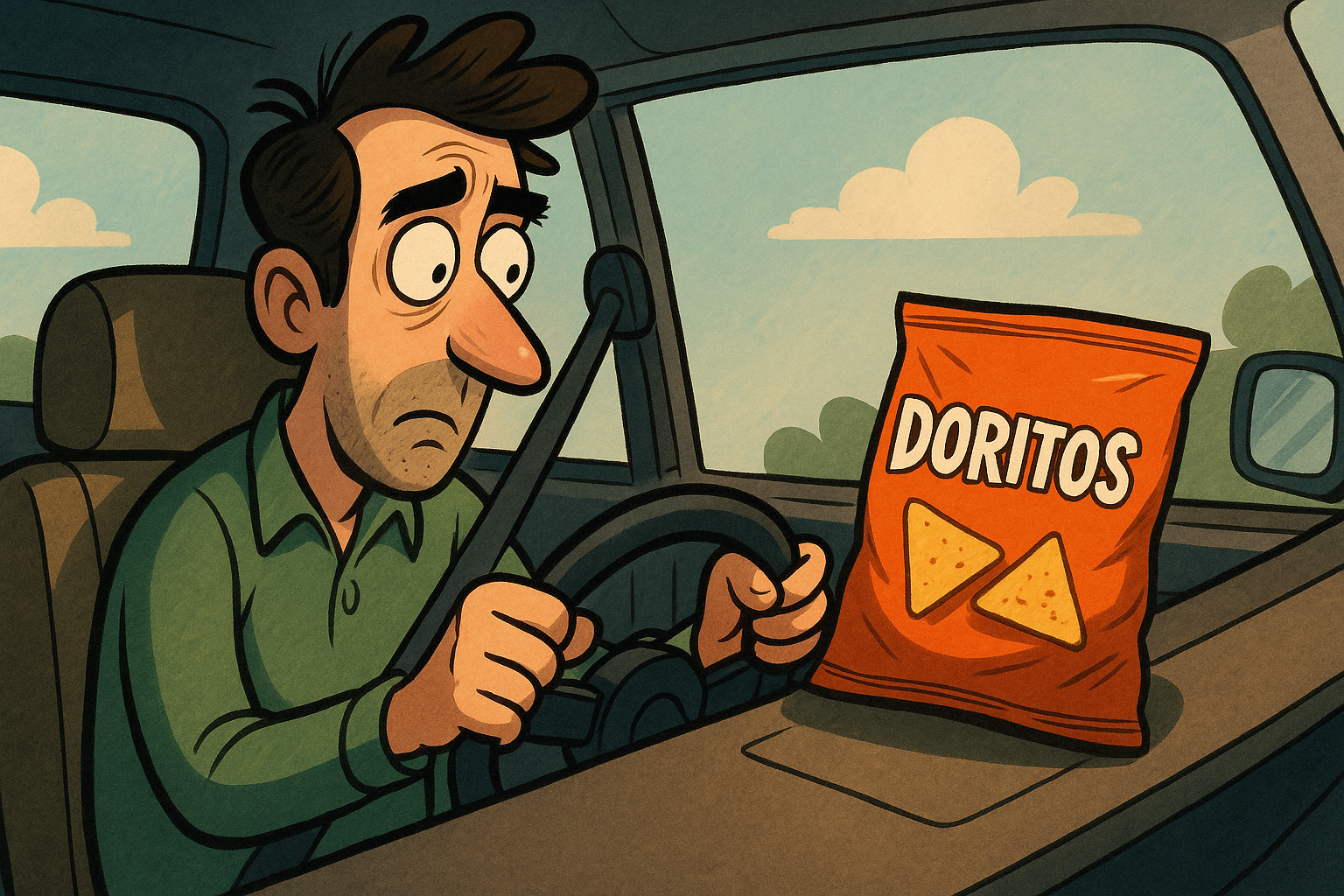
One cold day this past winter, I found myself driving home from a stressful set of meetings at my money-losing restaurant in Toronto, an unopened bag of Doritos in the passenger seat of my car. The Doritos, surprisingly, remained unopened for the entire drive.
Because.
I was listening to an audiobook with a title so absurd it could be either complete nonsense or the key to life: Busting Loose from the Money Game by Robert Scheinfeld. I was only listening because a friend had recommended the book, claiming it was about quantum mechanics, not money.
I had never heard of Robert Scheinfeld. I initially assumed this was some sort of mid-2000s get-rich-quick PDF scam. And its style is indeed overly salesy. But the content was deeper than I expected.
The book didn’t teach me how to hack the stock market or manifest a Lamborghini with my chakras. It taught me something far more dangerous: that nothing meant anything.
More precisely, it suggested that I was not who I thought I was, the world wasn’t what it seemed, and that all of the problems in my life were staged by someone who was clearly having a bit of fun with the script.
Scheinfeld calls that someone True Creative Essence, TCE for short. But because he uses so many storytelling metaphors in his teachings, I now think of this creative essence as the Author.
In Scheinfeld’s worldview, we live in a holographic simulation that was created by our higher selves as a life story to be experienced. The whole illusion, the whole Story, is powered by the infinite energy of the Author.
Here’s the mathematical argument that convinced me, first advanced by a physicist named Nick Bostrom in 2003, and more recently popularized by Elon Musk.
Do you think some day we’ll develop technology capable of creating an illusion as real as what we call reality? Yes, of course.
If we do develop that technology, will we create only one such simulation? No, we’ll create billions, trillions, more even.
What are the odds that we’re in an original world, vs one of those simulations? Pretty much zero.
Not convinced? Not my problem. Back to the book.
The coolest part of Busting Loose is that Scheinfeld says you can manipulate and use the infinite energy used by your higher self to create the simulation.
The book teaches a process that feels like emotional judo: when something in your life triggers you: an invoice, a stomach ache, a passive-aggressive email from a business partner, you focus on the emotion it causes. Not the problem. Not the story. Just the raw emotional texture of it.
Then you amplify the emotion. Not wallow in it, but amplify it. You picture yourself drawing energy out of the illusion around you, like sipping juice from the Matrix through a crazy straw. The emotion fades. Your shoulders drop. You walk away like a smug metaphysical ghostbuster.
Press enter or click to view image in full size
Sucking the emotions out of reality — created in DALL-E
The reason it works isn’t magical. By focusing on the emotion instead of your interpretation of the emotion or why it appeared, you begin the process of dissociating your thoughts from emotions. You think your emotions mean something? They don’t. They’re a soundtrack to your life, not harbingers of doom.
Like the soundtrack to the movie Jaws, emotions are meant to enhance the life experience, not add meaning where there is none. Just because you hear da-dum, da-dum, da-dum-dum-dum… doesn’t mean there’s a shark nearby. It just makes the movie more enjoyable. It adds depth to the experience.
That’s what emotions are: depth to the human experience. And when you focus on the emotional sensations and amplify them, you realize there’s nothing actually there.
I tried Scheinfeld’s four step process. And dammit, it worked. Remember the bag of Doritos? Neither did I.
I could go from anger or angst directly to peace in just a few minutes. Every time. And I started looking at my inner world the way one might look at a Roomba attempting to clean the drapes: suspiciously, but with growing respect.
I connected with Scheinfeld via Zoom, discussed how his worldview had evolved since he wrote the book, and learned it wasn’t the emotion-focusing process itself that was working. It was what the process revealed.
There is an unexamined assumption that every time you feel bad, it means something has gone wrong. And that assumption is a trick.
The Voice in my head (what Scheinfeld calls the Mind Machine) is like a rogue narrator that thinks it’s hosting a true crime documentary but is really just overdubbing a nature video with panic-inducing adjectives.
A tight chest becomes “anxiety” and thus a threat. A flicker of anger becomes a problem to fix. A thought about an ex becomes a sign you’re still emotionally stunted and probably always will be.
None of this is real. It’s voice-over.
The emotions? Fine. The sensations? Harmless. The thoughts? Just story fragments. What turns them into a psychological car crash is the Voice, desperate to glue everything together into a narrative arc it can feel important inside.
What I have come to understand, and what became the foundation of what I now call my worldview, is that my entire human experience is a Story. A novel. A life chosen by a higher version of me.
Consider me as an Avatar of the Author, a tiny spark of that divine essence. I chose to come to this world by choosing a novel to read, this particular Story that is Sanjay’s life. I’m both the reader of the story, and the main protagonist, except that until now, I’d completely forgotten my higher self.
Forgetting is what makes the illusion so much fun, if fun is the right word for something so bedeviled with highs, lows, and guard-rail busting plummets off emotional cliffs. Roller-coasters are fun too, until you get a headache and throw up that Slushee you bought an hour ago.
Then came the plot twist in my Story: realizing that the bundle of neuroses and preferences and plans everyone calls Sanjay isn’t actually in charge of anything.
The Voice in my head tells me I need to manage my thoughts, optimize my sleep, work on my marriage, go to therapy, start a podcast, heal my inner child, and maybe become a DJ. The Voice rarely shuts up.
But the truth is simpler. The Author already wrote this scene. I’m just living it.
I can decide where to place my attention. Consciousness is at the centre of the entire experience, and consciousness is simply awareness. That’s the only real freedom. I can watch my life like a good movie: laugh, cry, feel the tension, bite my nails, but remember not to try to leap onto the screen. That’s how you get a metaphysical concussion.
This worldview is what I’ll be exploring, in real time, with Robert Scheinfeld this September 13–17 in Toronto.
He’s coming out of retirement at my request to host a five-day Ultimate Freedom Experience, not because we think you need to learn something, but because we know how satisfying it is when you see the story behind the illusion. The Voice weakens. The story loses its weight, but retains its entertainment value.
You don’t become a better Character. You stop confusing yourself with the Character at all.
That doesn’t mean you float away. You still show up to work. You still kiss your kids goodnight. You still answer emails (although hopefully fewer of them). But you do it with a wink. You play your part with style, not stress.
I’ve spent the last few months living this way. Not perfectly. Not consistently. But increasingly. Call it early days. The first days of the rest of my life.
I’ve stopped trying to fix myself. I’m letting the scene play. I’m watching for the next surprise, the next twist, the next miracle hidden inside a delayed flight or a book recommendation.
I’m not offering enlightenment. I’m not promising transformation.
I’m watching a movie.
Come join me, if you think it’s part of your Story.