Realizing78 of 80
Ancient Chinese Wisdom, or Is It?
Westerners are suckers for anything that sounds mystical
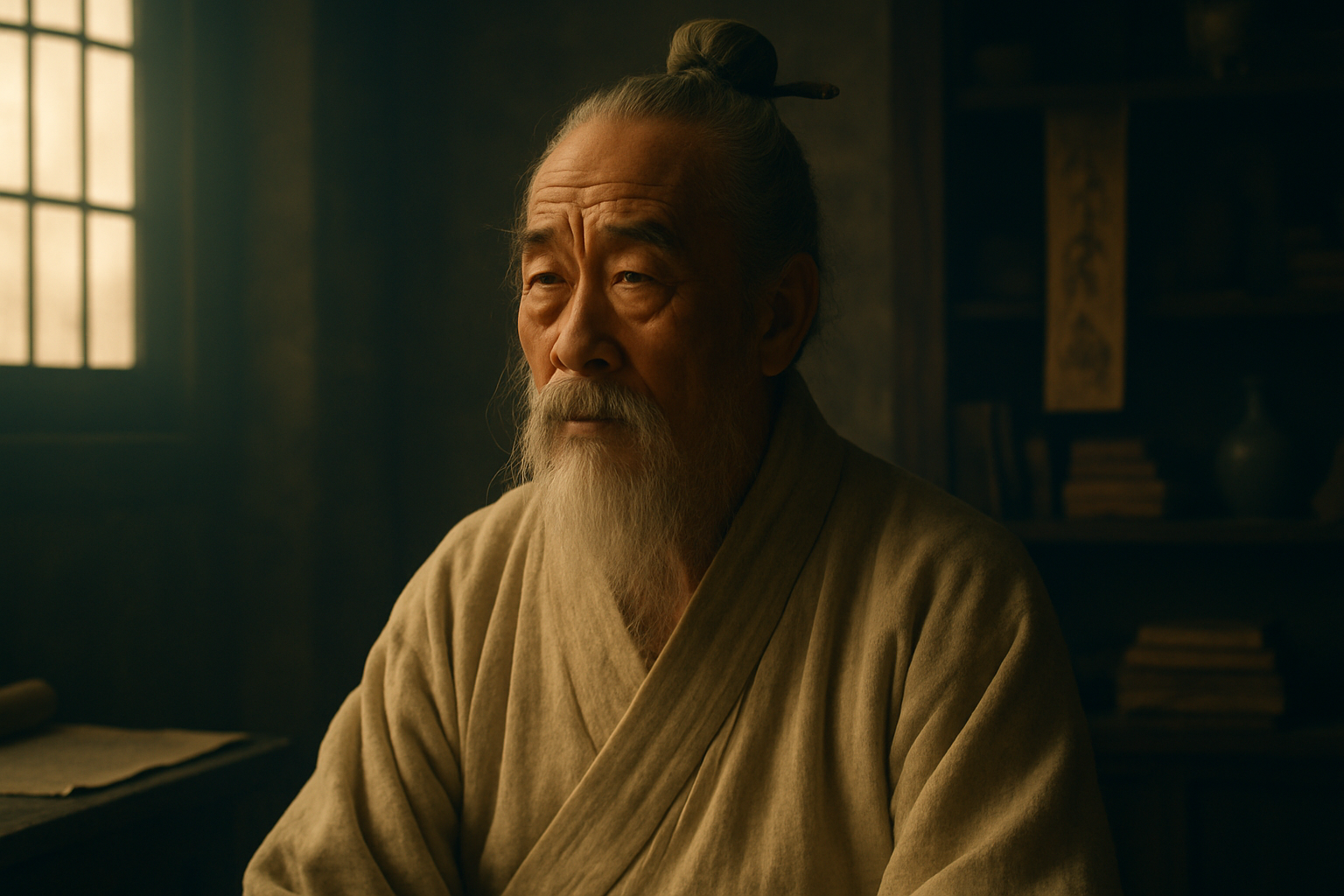
This might look like Wu Hsin — created in DALL-E
I’m working on a book about a new worldview I’ve stumbled upon. I’m calling this worldview the Uncult because a good worldview needs some hooks to help it spread, but those hooks should free you, not imprison you.
To aid in understanding the concepts of the Uncult, I’m going to write some parables. A parable is a fictional story told as if it happened to a person, and it reads like a good mini-story, easily comprehended by humans like you and me.
“Character” in my parables is the generic term for humans. Using the term “Character” helps to remind us that humans are also the work of an unseen author — a concept reflected in nearly all the world’s major belief systems.
Many of the themes in the Uncult worldview have been previously stated by an ancient Chinese philosopher named Wu Hsin, who existed around 400 BCE, a hundred years after Confucius. Wu Hsin has no Wikipedia page, no Linkedin handle, and no historical record of him exists, and yet there are books of his aphorisms. Here is an example:
The Infinite has no preferences.
It kisses both the darkness and
The light equally.
-Wu Hsin
It turns out that Mr. Hsin was created by a human Character named Roy Melvyn around 2010 in order to help propogate his own philosophical ideas. For my similar purposes, I’ve created a further fiction, a sister An Hsin, to act as a dramatic foil in my parables.
Why? Because it’s fun. Because copyright. And because An Hsin will help you internalize what you read about the Uncult.
Press enter or click to view image in full size
An Hsin, fictional, but so are you, and so am I — created in DALL-E
The Origin of Wu Hsin and An Hsin
(as passed down by those who never needed to remember)
Before thought had teeth,
Before language made mirrors,
There was only the Great Silence.
From this Silence, two ripples arose.
Not as opposites, but as complements
The space between notes,
And the stillness that hears them.
The first ripple did not move.
It was absence, wrapped in presence,
An echo that swallowed its own source.
They called him Wu Hsin — No Mind.
He came with no footsteps
And left no trace.
He pointed with empty hands
And said nothing that wasn’t already known.
The second ripple breathed warmth into stillness.
She hummed to flowers before they bloomed,
And calmed the moon when it forgot to rise.
They called her An Hsin — Quiet Mind.
She did not teach.
She reminded.
She was the lull in the storm,
The hand that cups your breath and says, “Stay.”
Wu wandered into the mountains.
An Hsin waited by the river.
He dissolved questions.
She soothed the need to ask.
One dissolves.
One embraces.
Together they make a path
That no map has dared to mark.
And so, the sages say:
To follow Wu is to vanish.
To follow An Hsin is to remain
Without resistance.
But to know them both —
To carry emptiness in one hand
And quiet in the other —
Is to walk the Middle Sky
Where even the gods forget your name