Achieving · Relationships32 of 80
My Mother Is Trying to Kill Me
A continuous glucose monitoring murder mystery
A deadly weapon, crafted with great care — Photo by Anshu A on Unsplash
“Here’s another one” she said, in a loving voice that belied the deadly intent behind her actions. I winced as the second Aloo Paratha slid onto my plate.
I looked over at my father, who shrugged his shoulders, as if to say, ‘it’s not going to kill you.’
Just then I received an alert on my phone.
Glucose Alert: Blood Glucose above alarm threshold of 13.0!
It was the second week of my trial of a continuous blood glucose monitoring system provided by Abbot Labs for free, and the first time I’d ever gotten an alert. I didn’t even know that there was such a thing! What was happening?
As my paratha grew cold, I quickly typed into my iPhone browser, ‘is blood glucose above 13.0 dangerous?’ and got the reassuring reply that it wasn’t ideal, but also not immediately dangerous. Whew, I was still alive, but my appetite was gone and I gave the extra paratha to my Dad.
Diabetes sucks. I’m pre-diabetic and genetically compromised as a South Asian male. With diabetes and heart attacks rampant in my genealogy there was no chance I was going to escape unscathed, and I had a heart attack when I was 41. In addition to all the subsequent heart meds, my doctor suggested I start taking Metformin to stave off diabetes as long as possible. When I asked him what the downsides were, he said “if your stomach and your wallet can handle it, there is no real downside.”
I say all this to show why I pay attention to anything to do with my health these days. After reading Outlive by Peter Attia, I started benchmarking everything. Grip strength, VO2 Max, Body Fat via Dexa Scan. Turns out I’m average for my age in all the stats. So far so good.
Attia also talks about the value of continuous glucose monitoring. My blood sugar metric, usually referred to as A1C, has been between 6 and 6.5 for the last 10 years. 5.7–6.5 = prediabetic. Over 6.5 is… diabetic. So when a friend sent me a link to get a free glucose monitoring kit from Abbot Labs, I jumped at it. Thanks Nav!
Over the course of 14 day free trial I became hyper-vigilant about what I ate. I was checking my blood glucose after every meal and I learned a few things:
Frequent smaller meals are better than two or three big meals, even if they’re exactly the same composition.
Calories in liquid form really spike blood sugar.
If I eat late at night, it takes a long time for my blood sugar to settle and my sleep is disturbed.
Revelations? Hardly. My nutritionist has told me the same things at my annual Medcan checkup. My trainer gave me the same rundown when I started training with him and he informed me 70% of all progress I was going to make was based on my eating habits.
Which isn’t to say it wasn’t a valuable experiment. The value of the monitor was that it slammed home vividly the effects of my eating habits. After the Paratha I decided to go have a healthy protein-laden Booster Juice (Ripped Berry, so yummy!).
Bam! Look at that graph. Another spike in blood sugar, but this time not lethal enough to get an alert. Damn. Drink that booster juice slowly, or don’t drink it at all.
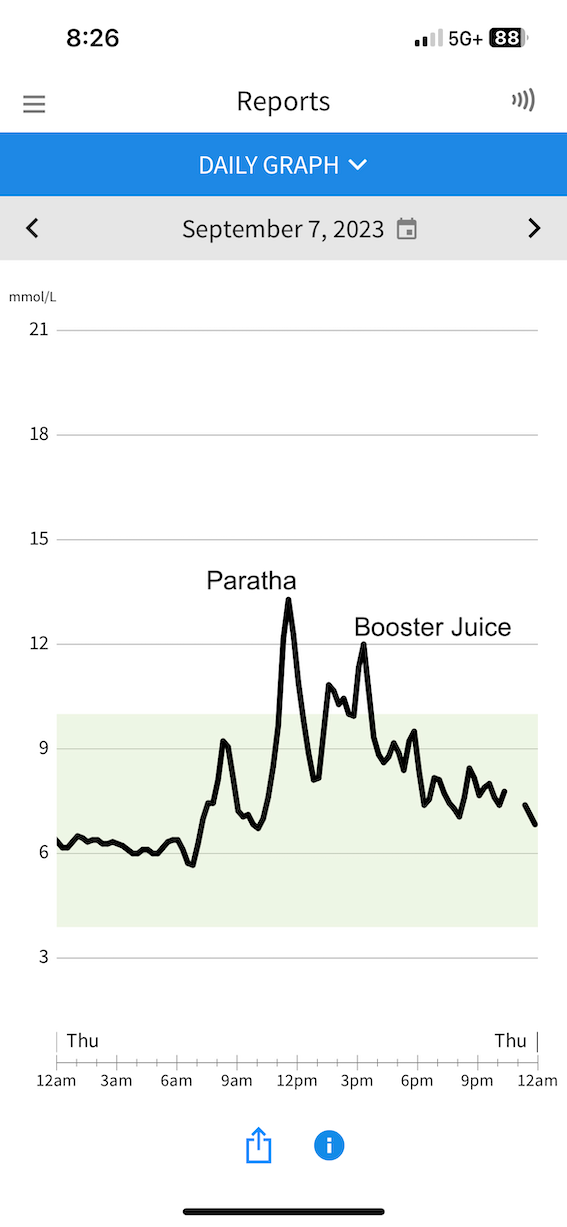
After two weeks I was exhausted from watching all my meals and stressing over blood sugar spikes. Food that never seemed to cause me any problems in terms of energy or how I felt now raised tingles in my spine as I held the phone to the device implanted on my arm after every meal. This is no way to live, I decided. And after two weeks of the free trial, I removed the device and am back to normal, whatever that is.
Press enter or click to view image in full size
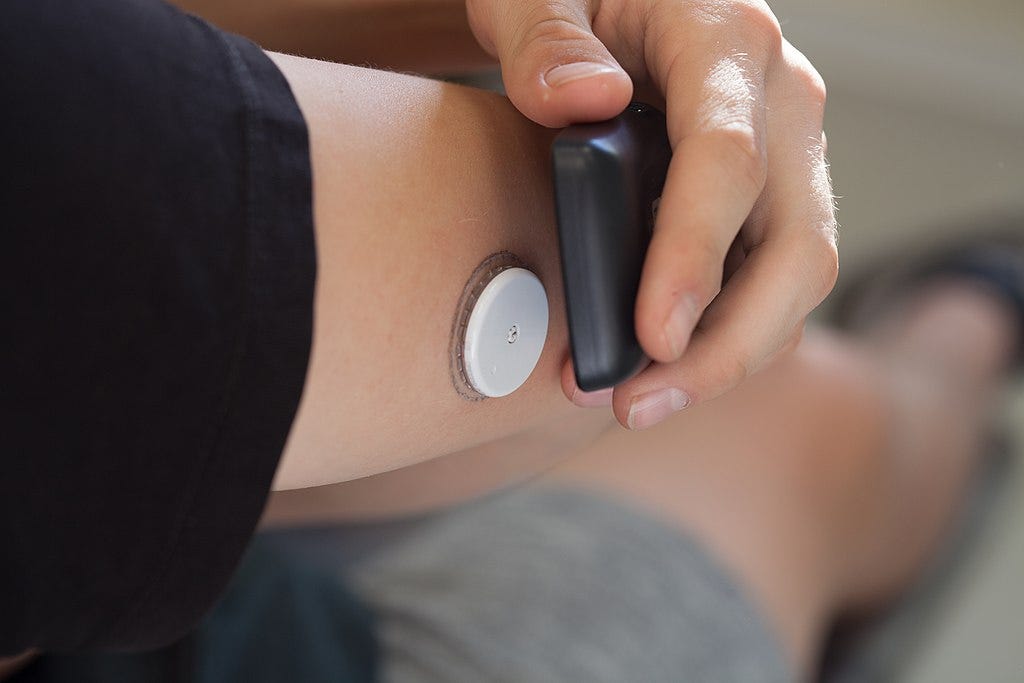
There’s no question that technology like this is a life saver for people with type 1 diabetes, or anyone having to time the manual injection of insulin. For me as someone living on the edge, it is a valuable reminder of lessons I already knew, but perhaps occasionally ignored. On the evening of day 13 I actually had a bit of a meltdown and as Trump thought with COVID-19 testing, I decided I could eat chocolate if I didn’t check the monitor afterwards. Then I had some more. And some Doritos. It didn’t kill me.
See below to get a free monitoring kit from Abbot in Canada, the offer is also available in the US. I know they’re doing this so they can eventually charge you $500 a month for refills to the monitor, but providing a two week free trial is a genuine benefit to the public good. Thank you Abbott, much appreciated. I’m not going to continue the trial — on top of everything else, my wife thought it was ugly and was happy I got it off. I suspect she also didn’t like the reminder of my mortality.
My mother grew up in a village in India in a different time. You ate everything on your plate, and you ate whenever someone gave you food. Obesity wasn’t the problem it is for us in the west now. She of course isn’t trying to kill me, but I have to be careful to eat well. One paratha is fine. Two I have to think about, but sometimes it’s ok.
After all, how do you measure a mother’s love? It certainly isn’t by blood sugar.
I Messed Up and My Mother Was the One Who Paid For It
Exploring the delicate balance between actions and words
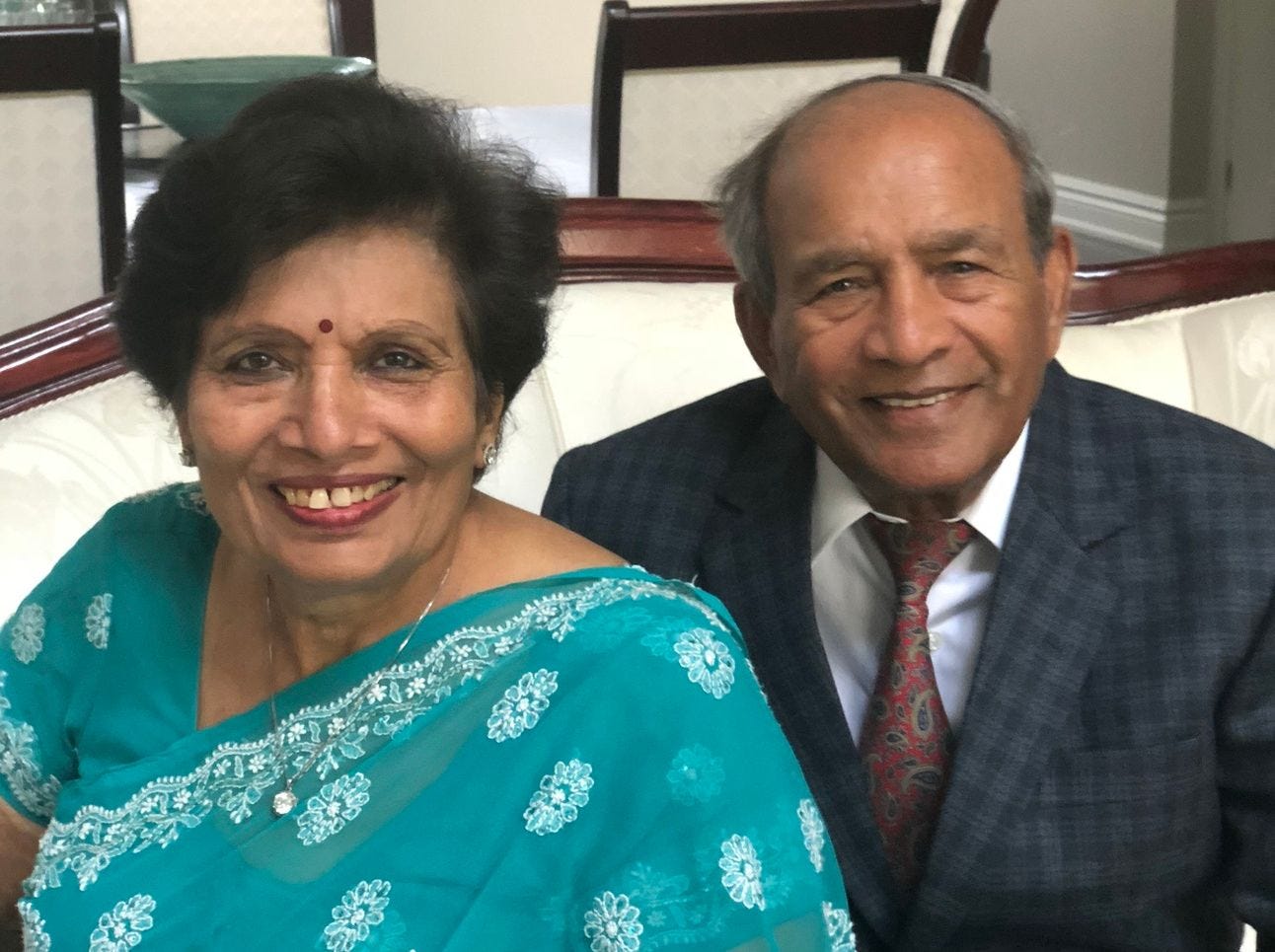
My Mom is the Best — photo by author
A week ago I was taught a valuable lesson by a woman who has taught me many valuable lessons over the years. I used the clickbait title ‘My Mother is Trying to Kill Me’ for an article about continuous glucose monitoring. I thought it was funny, because obviously I love my Mom, and I know she loves me. In our day-to-day and year-to-year interactions, we both demonstrate love and caring, and for her most of all, it’s in how she takes care of her family, including feeding us.
My entire adult life, if I haven’t seen my mother in a few days she’ll always prepare my favourite meals (kadhi, bindi, or aloo paratha) when I come to visit. I always eat everything and say “Thanks Mom, this tastes great!” because it does, and I appreciate it.
We’re taught that ‘actions speak louder than words,’ but what I was taught last week by my Mom is that words also matter. Titles matter.
I was in such a hurry to convey my experiences in life through my writing that I didn’t take the brief moment required to realize that not everyone knows how much I appreciate my mother’s love. Some people might read a title and a few words without reading or understanding what I was trying to say, that love isn’t about blood sugar, and in the scheme of things, I’ll take the food and the love over any little concerns I might have about caloric intake.
That day that I hit ‘publish’ I was a crappy writer and came across as an ungrateful son, and I apologize Mom. I’ll do better. I also apologize for the clickbait dear reader. Never again.
The good news is that my writing that article was the trigger for a long overdue conversation with my mother that allowed me to fully convey how much I appreciate her. Something I haven’t done enough of over the years.
Because I thought actions are what matter. And they do, but words also matter.
Don’t apologize for being late, be on time.
Don’t just say you love your kid, show up at their soccer game. Hug them good night.
Don’t just say “we should hang out soon.” Suggest a time, make a plan. Actions.
But you also have to say the words. The most power comes from actions in alignment with words. It has been shown repeatedly in social experiments that simply changing your behavior isn’t enough to change how you’re perceived, you must also remind people that you’ve changed to trigger a re-evaluation.
If you’ve decided to stop being habitually late, then you should say, “hey I’m on time!” every time you’re on time, and your friends will appreciate the change in behaviour. If you don’t say it, it’s harder for people to notice. And this works on yourself too. If you’re changing your diet, waking up earlier, or spending more time with friends, say it out loud to yourself and to others and it will reinforce the behavior.
In medical studies involving malpractice, it has been shown that patients don’t sue doctors who make mistakes, they overwhelmingly sue doctors that they don’t like. Doctors who have bad bedside manner, doctors who don’t say the right words.
Actions may speak louder than words, but think of actions as an amplifier. You still have to say the words.
You’re important to me. I value our relationship. I hope you get better. That was a great performance. Thank you for the hard work you put in this week.
Next time you’re demonstrating your love with actions — with a visit, with a hug, with a gift — add the words that I forgot.
I love you Mom.